“It is the harmony of the diverse parts, their symmetry, their happy balance; in a word it is all that introduces order, all that gives unity, that permits us to see clearly and to comprehend at once both the ensemble and the details.”
Henri Poincare
As an aspiring environmentalist and urban planner, I’ve found that the field is really all about balance. Much like taking bits away and adding pieces back on in an attempt to reach an equilibrium with a balance scale, approaches to biophilia often juggle with different elements and perspectives that must be considered. When applying biophilic design to urban planning, the same holds true.
In one of my recent History of Durham classes, we had the opportunity to listen to the mayor, Leonardo Williams, speak. While discussing his work, he introduced one of the major controversies he was facing: backlash against rezoning. Facing one of its biggest housing crises, new residential areas can be seen popping up all over the county. While how this solves the housing crisis is another layered topic for debate, Mayor Williams brought up how propositions for new construction areas to be multi-family zoning rather than single-family zoning were just barely passing through city council. While I personally love the urban environment and prefer more condensed urban design, I also understand how others —including one of my close friends who was also here for the guest speaker— see the appeal of single-family housing.
This is one aspect of harmonious living with nature —biophilia— that must be considered. Especially as more and more people are moving to cities, designing for both nature and urban density is yet another one of the balances that biophilic planning must tackle.
At the 2024 Biophilic Leadership Summit, Erica Spotswood and Robin Grossinger from Second Nature Ecology highlight the strategies that integrate natural ecosystems into densely populated areas, enhancing urban resilience and biodiversity. I want to share some of the information I learned from this presentation with you all!
What exactly is the connection between urban density and nature?
When it comes to creating more compact and denser cities, the first thought may be that using space for housing takes away from space available for nature. The study that Erica had introduced examined the nuances and specificities of how exactly denser cities affect nature and vice versa.
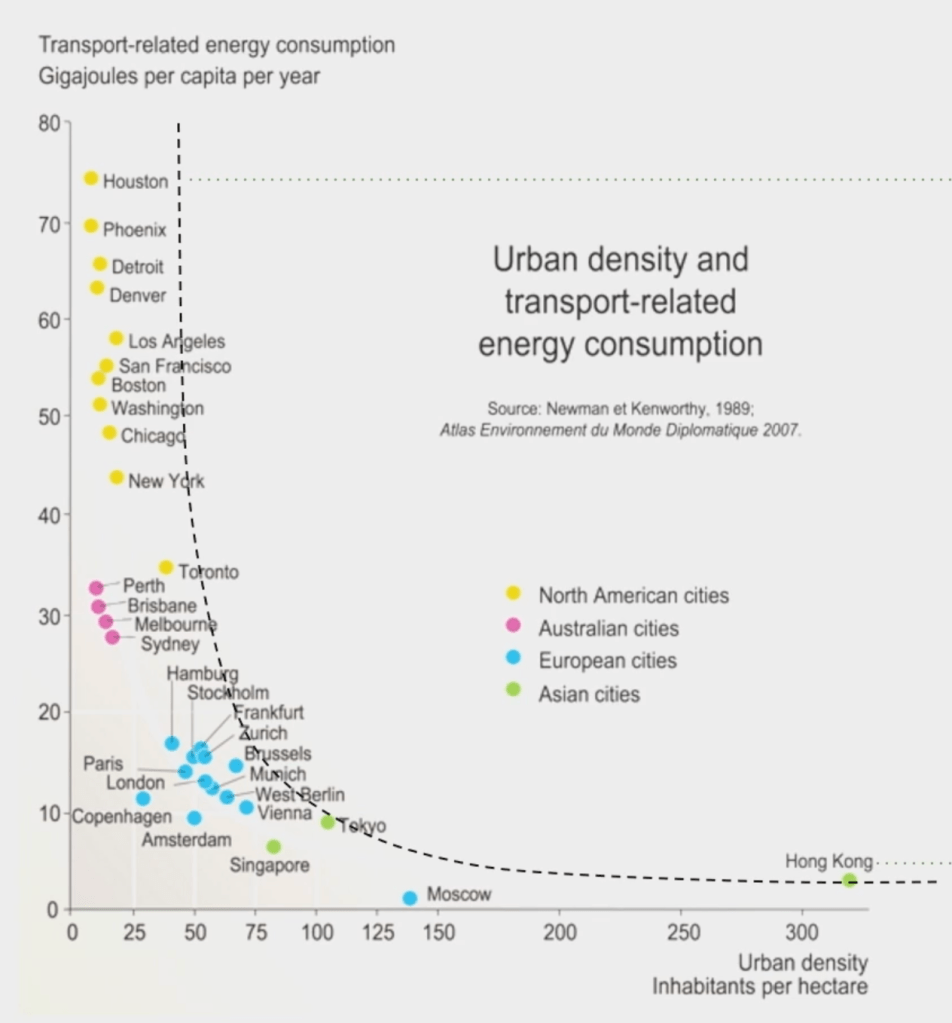
To start, due to less necessity placed on fossil-fuel burning transportation, from a denser community, there is less energy consumption; many United States cities veer towards the left of this graph. Beyond this, denser cities have also been proven to be more productive and creative, potentially due to the environments they tend to foster. At the same time, however, there may be penalties for urban psychological health.
This is where nature ties in. We’ve explored the mental health benefits of nature, and incorporating more of it into a cityscape may be the solution to the “lonely but not alone” feeling that some individuals in denser regions may face.
When it comes to finding that balance between density and nature, however, there is a sort of zone that is “just right” based on current case studies. A “Goldilocks” Zone, as it’s called, of between 5,000 and 12,000 people/km^2, where there is still a high chance for over 20% greenspace.
What does this actually look like?
Some examples that Erica explained are:
- Limited surface parking
- Green vacant lots
- Protecting large trees in the area
- Implementing multi-family homes rather than single-family ones to reduce sprawl
- Planting streets along the street and in between buildings in rows
Of course, all of this balance also comes with the added struggle of shifting American perspectives and lifestyles. The United States tends to value having an individual home more than other countries show. The scale I mentioned in the beginning is really more of a scale that’s being spun around and grabbed on different directions— the solution isn’t quite clear. The balance may never fully reach a stable state. All we can do in the meantime is work to steady as we learn more about its workings.
 Flourish
Leave a comment