
“Cultivation to the mind is as necessary as food to the body.”
Marcus Tullius Cicero
A group of students gather beneath towering trees. Reflections from the sunlight refract around them. Shadowy splotches glimmer as the wind pushes the branches above. They breathe open air. They are surrounded by green. They can hear the chirping of birds, the humming of insects nearby, and the whistle of the breeze. They have come here to learn about the importance of nature. Seated in a circle, a familiar narration of “The Lorax” begins…
I absolutely adore my school environment: the windows that they use, the plants that will pop up in every couple of classrooms, and the tree at the center of our campus. At the same time, however, I look at the bleak walls and geometric shapes and can’t help but wonder how it would feel to be in an environment that’s more harmonious with nature.
For years, classrooms have been largely sterile environments—rows of desks, harsh fluorescent lighting, and walls that separate students from the outside world, but biophilic living presents the opportunity to see the trees, birds, and sky not as distractions, but as but as vital enhancements to well-being and learning.
Benefits of Biophilic Learning
Despite my love for my education, I’ve found myself in the familiar boat of being unable to concentrate fully in a classroom. Spending on average 1080 hours per year in the same buildings can create quite a toll on one’s excitement. Luckily, integrating biophilic design into an academic environment comes with certain benefits for an learning.
Studies have shown that biophilic elements can:
- Sharpen focus/concentration
- Boost creativity
- Reduce stress
- Enhance memory
Case Study
Kakapo Creek Learning Centre in New Zealand
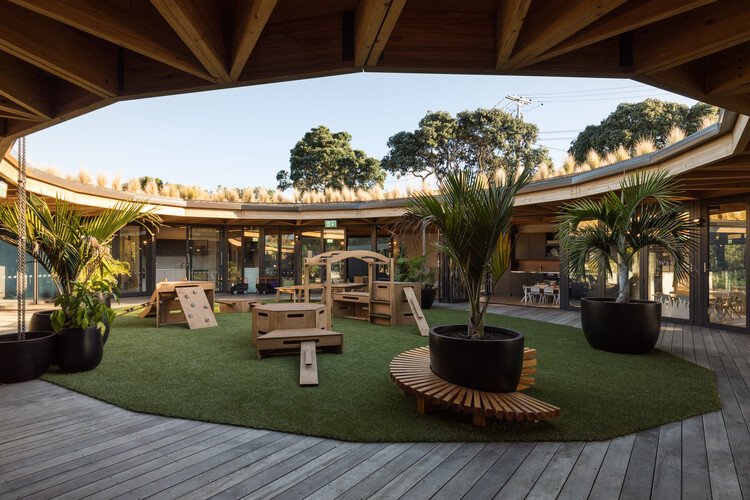
Everything about the center’s design is oriented around nature— from the usage of natural light to the open circulation of air in its rooms, it clearly considers eco-friendly design aspects. In fact, the three trees pictured above were removed from the site during construction, and are now being incorporated in the design— a great example of restorative thinking. Some of the materials used were recycled, and even the roof can filter rainwater for future usage. It provides a nourishing environment for children to learn and connect with nature.
Imagine now, how the gravity of “The Lorax” can really sink in.
“…and all that the Lorax left here in this mess, was a small pile of rocks, with the one word… ‘UNLESS.’ UNLESS someone like you cares a whole awful lot, nothing is going to get better. It’s not.”
 Flourish
Leave a comment